FIFA World Cup Trophy History: Who Owns and Keeps the Original Cup?
Every four years, the entire planet stops to watch the ultimate sporting spectacle: the FIFA World Cup. At the heart of this global obsession is a single, glittering prize that represents the pinnacle of football glory. However, the dramatic evolution of this global masterpiece is a story worth telling, and diving deep into the FIFA World Cup Trophy History reveals a narrative filled with political intrigue, daring heists, and miraculous discoveries. While millions of fans watch the winning captain hoist the iconic golden statuette, very few know the secrets behind its origin. Consequently, a fascinating question arises: who actually owns and keeps the original cup? In this article, we will embark on a comprehensive journey through history, examining how this trophy evolved from a simple silver-gilt statue into a multi-million-dollar cultural icon.
Table of Contents
- 1. The Evolution of a Legend: A Journey Through FIFA World Cup Trophy History
- 2. The Jules Rimet Trophy: The Drama of Early FIFA World Cup Trophy History
- 3. Unraveling the Mystery: Stolen and Lost in FIFA World Cup Trophy History
- 4. The Modern Era: The Design of the New FIFA World Cup Trophy History
- 5. Who Owns and Keeps the Original Cup in FIFA World Cup Trophy History?
- 6. Fascinating Milestones in FIFA World Cup Trophy History
- 7. Frequently Asked Questions (FAQs)
The Evolution of a Legend: A Journey Through FIFA World Cup Trophy History
To fully appreciate the magnitude of the World Cup, we must first understand how its physical prize came to be. As we analyze the earliest chapters of FIFA World Cup Trophy History, we can see that the trophy itself is more than just gold and stone; it is a physical manifestation of changing geopolitical eras. The competition was founded in 1928 under the leadership of FIFA President Jules Rimet, leading to the inaugural tournament in Uruguay in 1930.
Furthermore, the prize was not always the swirling golden globe we recognize today. In the early days, a single trophy was designed to transition from one champion to the next. Therefore, the trophy carried the emotional weight of multiple nations, accumulating history with every passing decade. Over the years, two distinct trophies have represented the pinnacle of world football, each with its own incredible, sometimes chaotic, timeline.
Meanwhile, the transition between these two designs highlights how the sport has grown from a localized tournament into a multi-billion-dollar global phenomenon. As football grew, so did the security, value, and prestige associated with its ultimate symbol of victory. Let us step back in time to explore the original trophy that started it all.
The Jules Rimet Trophy: The Drama of Early FIFA World Cup Trophy History
The story of soccer’s ultimate prize begins with the Jules Rimet Trophy, which served as the official award from 1930 to 1970. This original masterpiece played a central role in the foundational years of FIFA World Cup Trophy History. Designed by French sculptor Abel Lafleur, the trophy was initially named Victory but was later renamed in 1946 to honor Jules Rimet, the visionary FIFA president who established the tournament.
The original trophy was a stunning piece of Art Deco craftsmanship. It stood 35 centimeters tall and weighed approximately 3.8 kilograms. It featured a gold-plated sterling silver statuette of Nike, the ancient Greek goddess of victory, holding an octagonal cup above her head. The entire statue was set upon a beautiful blue base made of lapis lazuli, a semi-precious stone.
During World War II, the trophy’s safety was heavily threatened. To prevent Nazi forces from seizing the precious gold monument in Rome, the Vice President of FIFA and President of the Italian Football Federation, Ottorino Barassi, secretly removed the trophy from a bank vault. Consequently, he hid it in a humble shoebox under his bed for several years. This act of bravery preserved the cup for future generations to cherish.
Unraveling the Mystery: Stolen and Lost in FIFA World Cup Trophy History
Despite surviving a global war, the Jules Rimet Trophy could not escape the clutches of thieves. The year 1966 marked one of the most embarrassing moments in FIFA World Cup Trophy History when the prize was stolen in London. Just four months before England was scheduled to host the 1966 World Cup, the trophy disappeared from a public stamp exhibition at Westminster Central Hall.
A massive police investigation ensued, but the authorities were completely baffled. Fortunately, a heroic mongrel Collie dog named Pickles saved the day. While out for a walk with his owner in South London, Pickles sniffed out a package wrapped in newspaper hidden under a suburban hedge. This bizarre event remains one of the most famous and beloved stories in FIFA World Cup Trophy History, turning a simple dog into a global celebrity.
Unfortunately, the dark side of FIFA World Cup Trophy History struck again in 1983. In 1970, Brazil won their third World Cup title, earning the right to keep the Jules Rimet Trophy permanently according to FIFA rules at the time. However, on December 19, 1983, thieves broke into the Brazilian Football Confederation headquarters in Rio de Janeiro. They overpowered the night watchman and stole the legendary cup.
Tragically, the original Jules Rimet Trophy has never been recovered. It is widely believed that the thieves melted the gold-plated silver down into gold bars. However, some historians and investigators believe the trophy may have been sold intact to a private collector on the black market. Today, only a replica is displayed by the Brazilian Football Confederation, leaving a permanent gap in physical sports history.
The Modern Era: The Design of the New FIFA World Cup Trophy History
Following Brazil’s permanent acquisition of the Jules Rimet Trophy in 1970, FIFA needed to commission a brand-new prize. When FIFA commissioned a new design in 1971, it heralded a brand new chapter in FIFA World Cup Trophy History. The organization received 53 competitive submissions from sculptors across seven countries, looking for a design that captured the modern spirit of the sport.
Ultimately, the submission of Italian sculptor Silvio Gazzaniga was chosen. Gazzaniga’s creation was a radical departure from the traditional cup design. Instead of a goddess holding a cup, his design depicted two human figures rising in dynamic spirals from the base, stretching upward to support a highly detailed replica of the Earth. This design perfectly captured the universal energy, passion, and global reach of modern football.
In addition, the production of this new trophy was handled by the GDE Bertoni company in Milan, Italy, which still maintains and polishes the trophy to this day. The transition to this modern sculpture marked the birth of the iconic image we associate with football glory today.
The Iconic Design Characterizing Modern FIFA World Cup Trophy History
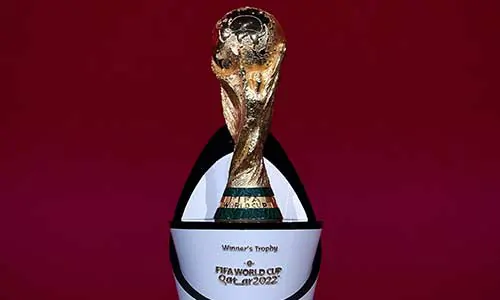
The physical specifications of this modern masterpiece are truly impressive. Italian sculptor Silvio Gazzaniga created an artistic masterpiece that would redefine FIFA World Cup Trophy History forever. The current trophy stands 36.8 centimeters (14.5 inches) tall and weighs a substantial 6.175 kilograms (13.6 pounds).
Moreover, it is constructed from 18-karat gold (75% pure gold), making it incredibly valuable based on metal content alone. The base of the trophy features two rings of green malachite, a beautiful semi-precious mineral that provides a striking visual contrast to the polished gold. The base is also engraved with the names of every winning nation since 1974, written in each country’s native language.
Interestingly, the trophy is actually hollow on the inside. If it were made of solid gold all the way through, it would weigh over 70 kilograms (154 pounds)! Such a weight would make it virtually impossible for players to lift over their heads during the iconic post-match celebrations.
Who Owns and Keeps the Original Cup in FIFA World Cup Trophy History?
Now, let us address the mystery that puzzles many football enthusiasts. Who actually owns the original trophy, and do the winning countries get to keep it? To answer the burning question of who keeps the original cup, we must look at how rules changed in FIFA World Cup Trophy History.
In the past, countries could win the right to keep the trophy permanently. However, FIFA realized that losing the physical cup repeatedly was unsustainable and risky. Consequently, FIFA changed its rules. Today, the original, solid-gold FIFA World Cup Trophy remains the permanent property of FIFA. It is never given to any country to keep permanently.
Instead, the original trophy is safely stored at the official FIFA World Football Museum in Zurich, Switzerland. The trophy only leaves its secure home for official promotional events, the FIFA World Cup Trophy Tour, and the actual final match of the tournament.
The Rules and Protocol of the Modern FIFA World Cup Trophy History
To protect the priceless artifact, FIFA enforces incredibly strict protocols. These tight protocols represent a necessary evolution in FIFA World Cup Trophy History to prevent another theft. Only an extremely exclusive group of people is legally allowed to touch the solid-gold trophy with their bare hands.
This exclusive group is strictly limited to:
- Players and managers who have actually won a FIFA World Cup tournament.
- Heads of state and presidents of sovereign nations.
Therefore, when a team wins the final, they are allowed to celebrate with the original trophy on the pitch for a brief period. However, as soon as the stadium celebrations conclude, FIFA officials take the original trophy back into secure custody. The winning nation is then presented with a replica, known as the FIFA World Cup Winners’ Trophy. This replica is made of bronze and plated with gold, serving as a permanent keepsake for the national association to display in their headquarters.
Fascinating Milestones in FIFA World Cup Trophy History
Throughout its existence, the tournament’s prize has witnessed incredible historical milestones. The following table provides a comprehensive overview of the key milestones in FIFA World Cup Trophy History, detailing the physical differences and histories of both legendary trophies:
In addition to these structural differences, the base of the current trophy has space for engravings that will eventually run out. The names of the winners are spiraled on the base, and expert calculations suggest that there is only enough space to accommodate winning nations until the 2038 World Cup. Consequently, FIFA will either have to redesign the base or commission a completely new trophy design before the centenary of the modern trophy.
Furthermore, the physical value of the current trophy is estimated to be over $20 million, making it one of the most expensive trophies in all of professional sports. However, its historical, emotional, and cultural value to billions of football fans around the globe is completely priceless.
Frequently Asked Questions (FAQs)
Q1: Is the current FIFA World Cup Trophy solid gold?
No, it is hollow on the inside. If it were solid gold all the way through, it would weigh over 70 kilograms, making it far too heavy for the players to lift. However, it is made of 18-karat solid gold sheets molded into its iconic shape.
Q2: Who is officially allowed to touch the original World Cup trophy?
Only World Cup-winning players, their managers, and heads of state are officially permitted to touch the original solid-gold trophy with their bare hands. All other handlers must wear white protective gloves.
Q3: Where is the original World Cup trophy kept?
The original trophy is permanently housed at the FIFA World Football Museum in Zurich, Switzerland. It only leaves the museum for the official FIFA World Cup Trophy Tour, the opening match, and the tournament final.
Q4: What happened to the original Jules Rimet Trophy?
After being awarded to Brazil permanently in 1970, the Jules Rimet Trophy was stolen from the Brazilian Football Confederation headquarters in Rio de Janeiro in 1983. It was never recovered and is widely believed to have been melted down by the thieves.
Q5: Do World Cup winners get to keep the trophy?
No, they do not keep the original solid-gold trophy. Instead, the winning national team is given a gold-plated bronze replica, known as the FIFA World Cup Winners’ Trophy, to keep permanently at their national headquarters.
Q6: How much is the original FIFA World Cup Trophy worth?
While its material value based on gold content is estimated around $550,000, its overall value—considering its immense historical, cultural, and sporting significance—is valued at approximately $20 million.
Conclusion: The Timeless Legacy of FIFA World Cup Trophy History
Ultimately, exploring the FIFA World Cup Trophy History reveals that the trophy is much more than gold and gemstone. It is a symbol of sweat, tears, and global unity. From the dramatic shoebox hiding place during World War II to the modern, high-security vault in Zurich, the trophy has lived a life as exciting as the matches played to win it. As we look forward to future tournaments, the mystique of the original solid-gold cup remains untamed.
What are your thoughts on the World Cup trophy? Do you think FIFA should ever allow a country to keep the original cup permanently again? Share this article with your fellow football fans, and let us know your opinions in the comments below!