FIFA World Cup Host Selection Process: Evolution Through the Years
The FIFA World Cup is the pinnacle of global sports, capturing the imagination of billions of fans every four years. However, before the first ball is kicked and the stadium lights turn on, an incredibly complex, highly competitive, and historically controversial process takes place behind the scenes: selecting the host nation. Over nearly a century, this system has transformed from informal meetings among football executives into a highly transparent, multi-billion-dollar bidding war. As the sporting world prepares for the groundbreaking FIFA World Cup 2026, understanding this evolution offers key insights into the geopolitics of sports. This article explores how the selection process evolved from closed-door decisions to the rigorous modern frameworks we see today.
- 1. The Early Era (1930–1954): Executive Selections and Geopolitics
- 2. The Continental Alternation System (1958–1998)
- 3. The Formal Rotation Policy (2002–2014)
- 4. The Bidding Scandals and the Urgent Call for Reform
- 5. How the FIFA World Cup 2026 Bidding Process Redefined Modern Hosting
- 6. Key Technical and Transparency Reforms Leading to the FIFA World Cup 2026
- 7. Strict Human Rights and Sustainability Criteria for the FIFA World Cup 2026
- 8. Comparative Analysis of Selection Eras
- 9. The Future of World Cup Hosting: Joint Bids and Broad Horizons
- 10. Conclusion and Final Thoughts
1. The Early Era (1930–1954): Executive Selections and Geopolitics
In the early days of international football, host selection was far from democratic. The inaugural tournament in 1930 was awarded to Uruguay by the FIFA Congress in 1929. Uruguay was chosen because it was celebrating its centenary of independence and was the reigning Olympic champion. Additionally, the Uruguayan government agreed to cover all travel and accommodation expenses for participating teams, which was a massive financial relief during the Great Depression.
Consequently, many European nations refused to make the arduous two-week sea voyage across the Atlantic, leaving only four European teams in the tournament. This highlighted the logistical difficulties of early global sports. To placate European federations, FIFA awarded the next two tournaments to Italy (1934) and France (1938).
However, the selection of France in 1938 caused immense outrage in South America. Many believed the tournament should alternate strictly between the two dominant footballing continents. As a result, Argentina and Uruguay boycotted the French tournament, demonstrating early on how host selection could spark political and regional division.
Following World War II, the tournament resumed in 1950, with Brazil chosen unopposed. In 1954, Switzerland was selected because it celebrated the 50th anniversary of FIFA’s founding, which was headquartered in Zurich. During this early era, decisions were made mostly by a small group of influential European and South American administrators, with little focus on formal technical bids.
2. The Continental Alternation System (1958–1998)
To avoid further boycotts and regional disputes, FIFA established an unwritten “alternation agreement” between Europe and the Americas. From 1958 to 1998, the tournament shifted back and forth between these two primary footballing regions. This system maintained stability and ensured that both South American and European powerhouses regularly enjoyed home advantage.
Specifically, Sweden hosted in 1958, followed by Chile in 1962, England in 1966, and Mexico in 1970. Although this system kept the peace, it largely excluded other emerging footballing regions, such as Asia, Africa, and North America. It also meant that bidding was not highly competitive, as potential hosts knew which continent was designated for each cycle.
Furthermore, unforeseen circumstances occasionally forced sudden changes. For instance, Colombia was originally selected to host the 1986 tournament. However, due to severe economic instability and infrastructure challenges, the Colombian government declared in 1982 that they could no longer afford to stage the event. Consequently, Mexico was chosen as the replacement host, becoming the first country to host the tournament twice.
By the 1990s, the financial potential of global football grew exponentially. FIFA began to realize that maintaining a strict bilateral alternation system limited the sport’s commercial expansion. Therefore, the decision to award the 1994 tournament to the United States was made with the explicit goal of developing the sport in a massive commercial market, laying an early foundation for what would later become the multi-national FIFA World Cup 2026 model.
3. The Formal Rotation Policy (2002–2014)
The dawn of the 21st century marked a radical departure from the traditional selection process. In 1996, FIFA took a historic step by awarding the 2002 tournament to Japan and South Korea. This was the first-ever joint bid in tournament history and the first time the event was hosted in Asia, proving that football was truly becoming a global game.
Following the highly contested and controversial bid for the 2006 tournament, which Germany won over South Africa by a single vote, FIFA formally established a continental rotation policy. Under this new rule, the right to host was rotated among FIFA’s six continental confederations to guarantee that developing football regions would have an opportunity to host.
Consequently, the 2010 tournament was awarded to South Africa, marking the first time the African continent hosted the event. Following the rotation cycle, Brazil was selected unopposed as the sole bidder for the 2014 edition. However, the rotation system proved to be short-lived.
Because Brazil was the only candidate for 2014, FIFA realized that a lack of bidding competition reduced their leverage to negotiate favorable financial and logistical terms. Therefore, in 2007, the FIFA Executive Committee decided to abandon the strict continental rotation policy, opening up the bidding process to any nation whose continental confederation had not hosted either of the previous two tournaments.
4. The Bidding Scandals and the Urgent Call for Reform
The host selection process reached its lowest point in December 2010, when the FIFA Executive Committee voted simultaneously on the hosts for both the 2018 and 2022 editions. The decision to award the tournaments to Russia and Qatar, respectively, sparked intense global controversy and allegations of widespread corruption, collusion, and bribery.
Historically, the power to select host nations rested in the hands of the FIFA Executive Committee—a small, elite group of just 24 individuals. This highly centralized voting structure was incredibly vulnerable to lobbying, backroom deals, and unethical practices. Subsequent independent investigations, including the famous Garcia Report, exposed deep systemic flaws within the organization’s governance.
In response to the public outcry, several executive committee members were suspended, and FIFA underwent a massive organizational restructuring. It became clear that if the organization wanted to maintain its credibility, the entire bidding process had to be rebuilt from the ground up, with a focus on transparency, objectivity, and democratic voting.
5. How the FIFA World Cup 2026 Bidding Process Redefined Modern Hosting
The bidding process for the FIFA World Cup 2026 served as the ultimate testing ground for FIFA’s newly implemented reforms. This cycle marked the first time the host was not selected by the executive committee. Instead, the responsibility was given to the entire FIFA Congress, where all 211 member associations held an equal vote.
Additionally, for the first time in history, every individual vote was made completely public. This transparent approach was designed to eliminate backroom political deals and ensure absolute accountability. The main competition for the FIFA World Cup 2026 was between Morocco and the joint “United Bid” submitted by Canada, Mexico, and the United States.
On June 13, 2018, at the 68th FIFA Congress in Moscow, the United Bid won the vote with 134 votes to Morocco’s 65. Because the tournament was expanding to a massive 48-team format, the requirements for infrastructure, stadiums, and logistics were higher than ever before. The success of the United Bid highlighted a major shift in hosting strategy, proving that co-hosting and utilizing existing world-class infrastructure would be the preferred path forward for future tournament cycles.
6. Key Technical and Transparency Reforms Leading to the FIFA World Cup 2026
To ensure that host countries are chosen on objective merit rather than political influence, FIFA introduced a highly detailed evaluation system. Prior to the vote for the FIFA World Cup 2026, a specialized technical task force conducted thorough on-site inspections of all bidding nations, scoring them across multiple categories.
These evaluation reports scored each bid on a scale from 0 to 5, analyzing key technical components such as:
- Stadium infrastructure, seating capacities, and pitch quality.
- Transport, airport capacity, and public transit networks.
- Team facilities, accommodation, and training sites.
- Estimated organizing costs and potential media revenue.
Consequently, any bid that failed to meet the minimum score in critical areas was disqualified before reaching the final vote. This system ensures that future hosts have the actual operational capacity to manage a major global sporting event, avoiding the severe stadium abandonment issues seen in some previous editions.
7. Strict Human Rights and Sustainability Criteria for the FIFA World Cup 2026
Another major milestone in the evolution of the selection process was the integration of human rights and environmental sustainability criteria. In alignment with the United Nations Guiding Principles on Business and Human Rights, FIFA made these aspects legally binding components of the bidding requirements starting with the FIFA World Cup 2026.
Specifically, bidding countries must submit detailed strategies outlining how they plan to safeguard labor rights, prevent discrimination, and protect freedom of expression. Furthermore, hosts are now required to implement strict waste management, energy-efficient operations, and sustainable transport solutions during the tournament.
Therefore, hosting a modern World Cup is no longer just about building grand stadiums; it is about ensuring a positive, ethical, and long-lasting legacy for the local community and the environment. These criteria have now become the benchmark for all future sports bidding processes worldwide.
8. Comparative Analysis of Selection Eras
To better understand how much the process has evolved over the decades, the table below compares the key characteristics of host selection throughout different eras of FIFA history:
| Selection Era | Main Voting Body | Primary Focus | Transparency Level |
|---|---|---|---|
| Early Era (1930–1954) | FIFA Executive Committee (Very Small Group) | Geopolitics, historical anniversaries, financial coverage | Very Low (Closed-door negotiations) |
| Continental Alternation (1958–1998) | FIFA Executive Committee | Regional balance between Europe and the Americas | Low (Unwritten agreements and simple votes) |
| Rotation & Crisis (2002–2014) | Executive Committee (24 members) | Expanding global reach, commercialization, intense lobbying | Low to Medium (High vulnerability to corruption) |
| Modern Reform Era (2026–Present) | FIFA Congress (All 211 member countries) | Technical capacity, human rights, public votes, sustainability | High (Scores and individual votes published openly) |
9. The Future of World Cup Hosting: Joint Bids and Broad Horizons
The successful transition to a 48-team tournament for the FIFA World Cup 2026 has set a new standard for the future of sports mega-events. Because hosting a tournament of this scale requires at least 16 modern stadiums and massive transit networks, single-nation bids are becoming increasingly rare and difficult to sustain financially.
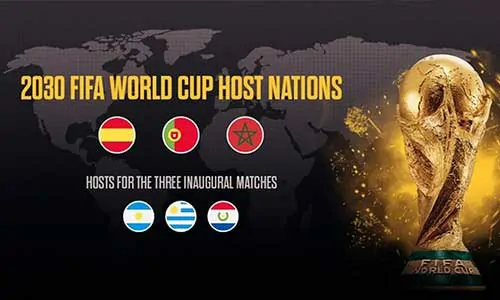
We can clearly see this trend continuing in subsequent selections. For example, the 2030 tournament is set to be a truly global event, spanning three continents and six host countries (Spain, Portugal, and Morocco as primary hosts, with celebratory matches in Uruguay, Argentina, and Paraguay). This illustrates how the concept of hosting has evolved from a single city or country to a multinational celebration of football.
For more details on the latest official announcements, tournament rules, and upcoming milestones, you can check the Official FIFA Website, or explore detailed football coverage on BBC Sport. Ultimately, joint bids help distribute the immense economic costs and infrastructure demands of the tournament, making hosting a viable option for countries that might otherwise be unable to stage the event alone.
10. Conclusion and Final Thoughts
The journey of the FIFA World Cup host selection process reflects the broader evolution of modern sports management. What began as a series of closed-door executive meetings has grown into a highly structured, democratic, and transparent process that values infrastructural capacity, human rights, and environmental sustainability above political influence. The reforms that paved the way for the FIFA World Cup 2026 have successfully restored a degree of trust in global sports governance.
As we look forward to future tournaments, the focus will undoubtedly remain on shared responsibility, minimizing environmental impact, and creating lasting positive legacies for host communities. How do you feel about the transition to multi-country hosting formats? Let us know in the comments below, and don’t forget to share this article with your fellow football fans!
Frequently Asked Questions (FAQ)
1. How was the host for the FIFA World Cup 2026 chosen?
The host for the FIFA World Cup 2026 was chosen through a democratic vote at the 68th FIFA Congress in Moscow. For the first time, all 211 member associations voted publicly, selecting the joint United Bid of Canada, Mexico, and the United States over Morocco’s bid.
2. Why did FIFA change the host selection voting system?
FIFA overhauled the voting system in response to corruption allegations surrounding the 2018 and 2022 selections. Previously, only the 24-member Executive Committee voted. Now, the entire FIFA Congress votes, and the results are published openly to ensure transparency.
3. What are the main requirements to host a modern World Cup?
Modern hosts must meet strict requirements, including high-capacity stadiums, extensive transport infrastructure, modern training facilities, and robust security. Starting with the FIFA World Cup 2026, bids must also meet strict human rights and environmental sustainability criteria.
4. Can two or more countries host the World Cup together?
Yes, joint hosting is now highly encouraged. Co-hosting helps distribute the massive costs and logistical demands of a 48-team tournament, as demonstrated by the FIFA World Cup 2026 and the plans for the 2030 tournament.
5. What was the continental rotation policy?
The continental rotation policy, used between 2002 and 2014, dictated that the hosting rights would rotate among FIFA’s continental confederations. This system was designed to ensure developing football regions had the opportunity to host, but was later abandoned to increase bidding competition.
6. What role do human rights play in modern host selection?
Human rights are now a legally binding component of the bidding requirements. Potential hosts must provide comprehensive strategies to protect labor rights, ensure non-discrimination, and protect free speech, establishing a positive social legacy.