Football Formations Guide: From 4-4-2 to Today’s Tactical Systems
Tactical flexibility has become the defining characteristic of modern football. While managers once stuck to rigid shapes for entire seasons, today’s tactical landscape is fluid and constantly evolving. To truly appreciate the modern game, understanding the strategic layouts on the pitch is essential.
Welcome to the ultimate Football Formations Guide, where we dissect how teams organize themselves on the pitch. Whether you are an aspiring coach, a tactical analyst, or a passionate fan, this comprehensive guide will walk you through the evolution, strengths, weaknesses, and modern applications of football’s most influential setups.
Table of Contents
- 1. Why Every Fan and Coach Needs a Football Formations Guide
- 2. Historical Context: The Evolution of Tactical Systems
- 3. The Classic 4-4-2: The Foundation of Modern Defending
- 4. The Modern 4-3-3: Dominating Possession and Spaces
- 5. The Versatile 4-2-3-1: Balance and Creative Freedom
- 6. The Resurgence of Three-at-the-Back: The 3-5-2 and 3-4-3
- 7. Modern Hybrid Systems and Positional Play (Juego de Posición)
- 8. Comparative Analysis of Key Formations
- 9. Practical Applications: How to Apply This Football Formations Guide
- 10. Conclusion and Next Steps
- 11. Frequently Asked Questions (FAQ)
1. Why Every Fan and Coach Needs a Football Formations Guide
Formations are much more than numbers printed on a television screen before kickoff. They represent a manager’s philosophy, defensive blueprint, and attacking roadmap. Understanding these structures allows you to read the game on a deeper level.
Additionally, a solid Football Formations Guide helps identify why certain player matchups happen, how spaces are created in transition, and how managers adapt to in-game challenges. By understanding these structural patterns, you can appreciate the chess match happening on the grass.
2. Historical Context: The Evolution of Tactical Systems
In the early days of football, tactical systems were heavily skewed toward attacking. The historical journey of tactical evolution is a fascinating transition from chaotic offense to structured, disciplined organization.
The 2-3-5 Pyramid
Popularized in the late 19th century, the “Pyramid” was the first standardized tactical system. It featured two fullbacks, three half-backs, and five forwards. The primary objective was simple: advance the ball quickly and overwhelm the opponent’s goal with numbers.
The W-M Formation (3-2-2-3)
In response to the offside rule change in 1925, legendary Arsenal manager Herbert Chapman created the W-M formation. By dropping a central half-back into the defensive line, he created a three-man defense. This system divided the midfield into a box-like structure, offering a much higher degree of defensive stability.
Catenaccio: The Art of the Lock
Originating in Switzerland but perfected in Italy by Helenio Herrera at Inter Milan during the 1960s, Catenaccio introduced a defensive sweeper (the libero) behind a deep backline. This defensive-first mentality prioritized clean sheets and rapid, direct counter-attacks.
3. The Classic 4-4-2: The Foundation of Modern Defending
If you ask any football fan about traditional formations, the 4-4-2 is inevitably the first that comes to mind. It was the absolute standard across European football during the 1980s and 1990s, utilized famously by Arrigo Sacchi’s legendary AC Milan side.
This layout utilizes two flat banks of four in defense and midfield, supported by two strikers up front. It is celebrated for its symmetry, simplicity, and excellent coverage of the pitch’s wide areas.
Strengths of the 4-4-2
- Defensive Solidity: The two blocks of four make it incredibly difficult for opposing teams to find passing lanes through the center.
- Direct Attacking Routes: Having two strikers allows for simple, direct play, where one target man can flick long balls down to a faster partner.
- Clear Roles: Players have simple, well-defined responsibilities, making the system easy to teach and execute.
Weaknesses of the 4-4-2
- Midfield Overload: When playing against modern three-man midfields, a two-man midfield in a 4-4-2 is easily outnumbered and starved of possession.
- Predictability: Because the system relies heavily on wide play and crosses, structured defenses can find it relatively straightforward to defend against.
4. The Modern 4-3-3: Dominating Possession and Spaces
Pioneered by Rinus Michels and Johan Cruyff as part of their “Total Football” philosophy, the 4-3-3 has become the ultimate possession-oriented system. It has been refined in the modern era by managers like Pep Guardiola and Jurgen Klopp.
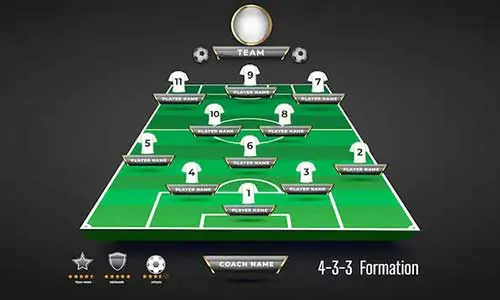
The 4-3-3 consists of a back four, a three-man midfield (typically featuring one deep playmaker and two advanced central midfielders), and two wide wingers flanking a central striker.
The Role of the Midfield Trio
The magic of the 4-3-3 lies in its midfield. The deep-lying defensive midfielder (often referred to as a “Regista” or “Pivot”) protects the defense and initiates build-up play. Meanwhile, the other two midfielders act as the engines, pushing forward to create overloads in the half-spaces or dropping back to help defend.
High Pressing and Inverted Wingers
In modern variations, wingers often tuck inside onto their stronger feet (inverted wingers), allowing full-backs to overlap and provide width. This setup is highly effective for counter-pressing, as the high positioning of players allows them to win the ball back immediately after losing possession.
5. The Versatile 4-2-3-1: Balance and Creative Freedom
During the late 2000s and early 2010s, the 4-2-3-1 emerged as the dominant formation in world football. It served as the tactical foundation for Spain’s World Cup victory in 2010 and Jose Mourinho’s treble-winning Inter Milan.
This system utilizes a defensive block of four, a “double pivot” (two defensive midfielders), three attacking midfielders (one central playmaker and two wingers), and a lone striker.
The Importance of the Double Pivot
The double pivot provides unparalleled defensive security. Typically, one midfielder acts as a destroyer (winning tackles and breaking up plays), while the other acts as a deep-lying progressor (passing the ball forward to creative players).
The Number 10 Role
The central attacking midfielder in this system, often called the “Number 10”, is given complete creative freedom to operate in the space between the opponent’s midfield and defensive lines. They are responsible for delivering key passes, driving at defenders, and arriving late in the box to score.
6. The Resurgence of Three-at-the-Back: The 3-5-2 and 3-4-3
Once considered outdated, three-at-the-back systems have experienced a massive renaissance in modern football. Managers like Antonio Conte and Gian Piero Gasperini have demonstrated how these formations can dominate both domestically and in European competitions.
The 3-5-2 Formation
This setup uses three central defenders, two wing-backs, three central midfielders, and two forwards. It is highly flexible, transforming into a defensive 5-3-2 when out of possession, and an attacking 3-1-4-2 during build-up.
The Crucial Role of Wing-Backs
In any three-at-the-back system, the wing-backs are the hardest working players on the pitch. They are tasked with defending the flanks, acting as extra defenders when off the ball, while also providing the primary width in attack, essentially playing as wingers when their team dominates possession.
7. Modern Hybrid Systems and Positional Play (Juego de Posición)
In the highly tactical world of modern football, rigid formations have given way to hybrid systems. Teams now regularly deploy one structure when defending and an entirely different shape when in possession of the ball.
For example, Pep Guardiola’s Manchester City frequently defends in a structured 4-4-2 or 4-3-3 shape. However, during build-up, a fullback or a central defender (like John Stones) steps into the midfield, transforming the shape into a highly fluid 3-2-4-1. This creates a box midfield that guarantees central passing options and helps control transitions.
Similarly, Roberto De Zerbi popularized a build-up style using a deep 4-2-4 or 4-2-2-2, inviting the opponent’s press to create massive gaps behind the midfield line, which are then ruthlessly exploited by rapid forward passes.
8. Comparative Analysis of Key Formations
To help visualize how these different systems compare, refer to this detailed comparative table mapping out their core characteristics:
| Formation | Defensive Stability | Midfield Control | Attacking Fluidity | Key Player Role |
|---|---|---|---|---|
| 4-4-2 | High | Low | Moderate | Box-to-Box Midfielders |
| 4-3-3 | Moderate | Very High | Very High | Single Pivot (Regista) |
| 4-2-3-1 | High | High | High | Central Playmaker (No. 10) |
| 3-5-2 | Very High | High | Moderate | Wing-Backs |
9. Practical Applications: How to Apply This Football Formations Guide
If you are coaching a local team or setting up a tactical board, selecting the right system requires analyzing your squad’s unique profiles. Here are some actionable steps to implement the concepts in this Football Formations Guide:
- Analyze Your Midfield Strengths: If you have technically gifted, high-stamina midfielders, consider a 4-3-3 to dominate possession. If you have limited passing options, a robust 4-4-2 or 3-5-2 may yield better defensive structure.
- Evaluate Your Fullbacks: Do your wide defenders love to join the attack? If so, look into a three-at-the-back system (like 3-5-2) to free them up as wing-backs. If they are more defensively minded, a traditional back four is much more secure.
- Adapt to Your Opponent: Tactical flexibility is crucial. If your opponent dominates the central midfield, be prepared to shift from a flat two-man midfield to a three-man midfield in order to match their numbers.
For more deep dives into professional coaching methodologies, you can explore tactical breakdown resources on The Coaches’ Voice, which provides incredible insights directly from top-tier professional managers.
10. Conclusion and Next Steps
Football is a highly dynamic game, and formations are the fundamental building blocks of its tactical beauty. From the structured defensive blocks of the traditional 4-4-2 to the fluid, space-exploiting hybrid shapes of modern possession football, each tactical system offers a unique way to solve the game’s ultimate puzzle: scoring goals while protecting your own net.
As you watch your next live match, try to look past where the ball is. Instead, observe the off-the-ball shapes of the players, how the full-backs position themselves, and how the midfield unit shifts. You will quickly begin to spot the intricate tactical systems discussed in this guide in real-time.
If you want to stay up to date with the latest tactical analyses and developments from major tournaments, check out UEFA’s official tactical analysis reports for elite matches.
What is your favorite tactical system to watch or coach? Let us know in the comments below, and share this guide with your teammates or fellow football enthusiasts!
11. Frequently Asked Questions (FAQ)
What is the most balanced football formation?
The 4-2-3-1 is widely considered the most balanced modern formation. It provides excellent defensive cover with a double pivot while offering creative freedom for the attacking midfielders and wingers.
Why did the classic flat 4-4-2 lose popularity?
The flat 4-4-2 fell out of favor primarily because it was easily overrun in midfield. Modern formations using three central midfielders (like the 4-3-3) can easily isolate and dominate a two-man midfield.
What is a hybrid formation in modern football?
A hybrid formation is a tactical system where a team changes its shape depending on whether they are in possession or out of possession. An example is defending in a 4-4-2 but building up in a 3-2-4-1.
How does the ‘False 9’ impact modern tactics?
A False 9 is a striker who drops deep into the midfield rather than staying on the last line of defense. This pulls central defenders out of position, creating space for inverted wingers to exploit.
Which formation is best for counter-attacking football?
Formations like the 5-3-2 or 4-5-1 are highly effective for counter-attacking. They compress defensive spaces in a low block and utilize fast transition play to release wingers and forwards into space.