UEFA Champions League Winners List: Every Champion Since 1956
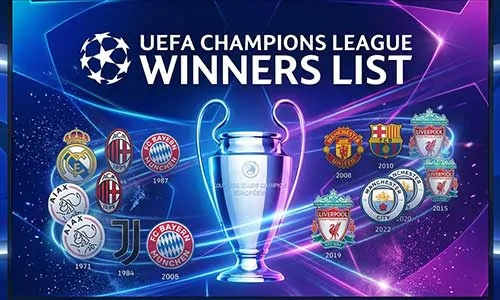
When we look at the ultimate achievements in club football, the UEFA Champions League Winners List stands as the ultimate catalog of glory. Known originally as the European Champion Clubs’ Cup, this legendary tournament has defined footballing excellence since its inception in 1955. From the iconic white shirts of Real Madrid to the modern dominance of Paris Saint-Germain, lifting the “Big Ears” trophy is the pinnacle of every professional player’s career.
According to the official UEFA Official Website, the competition represents the highest standard of club soccer in the world. Consequently, the journey to becoming a European champion is filled with drama, legendary matches, and historic upsets. In this comprehensive guide, we explore the complete history of the competition, analyzing the teams, eras, and nations that have shaped European football history.
Table of Contents
- 1. The Complete UEFA Champions League Winners List (1956–2026)
- 2. Clubs with the Most Titles on the UEFA Champions League Winners List
- 3. Analyzing the UEFA Champions League Winners List by Era
- 4. Dominant Nations in the UEFA Champions League Winners List
- 5. Memorable Finals and Historic Underdogs
- 6. Frequently Asked Questions (FAQ)
The Complete UEFA Champions League Winners List (1956–2026)
Below, we have assembled the complete, year-by-year UEFA Champions League Winners List, showing every champion, runner-up, and final score since the inaugural 1955–56 season up to the 2025–26 season. This extensive database includes the classic European Cup era and the modern rebranded Champions League tournament.
| Season | Winner | Score | Runner-up |
|---|---|---|---|
| 2025–26 | Paris Saint-Germain (FRA) | 1–1 (4–3 pen) | Arsenal (ENG) |
| 2024–25 | Paris Saint-Germain (FRA) | 5–0 | Inter Milan (ITA) |
| 2023–24 | Real Madrid (ESP) | 2–0 | Borussia Dortmund (GER) |
| 2022–23 | Manchester City (ENG) | 1–0 | Inter Milan (ITA) |
| 2021–22 | Real Madrid (ESP) | 1–0 | Liverpool (ENG) |
| 2020–21 | Chelsea (ENG) | 1–0 | Manchester City (ENG) |
| 2019–20 | Bayern Munich (GER) | 1–0 | Paris Saint-Germain (FRA) |
| 2018–19 | Liverpool (ENG) | 2–0 | Tottenham Hotspur (ENG) |
| 2017–18 | Real Madrid (ESP) | 3–1 | Liverpool (ENG) |
| 2016–17 | Real Madrid (ESP) | 4–1 | Juventus (ITA) |
| 2015–16 | Real Madrid (ESP) | 1–1 (5–3 pen) | Atletico Madrid (ESP) |
| 2014–15 | Barcelona (ESP) | 3–1 | Juventus (ITA) |
| 2013–14 | Real Madrid (ESP) | 4–1 (aet) | Atletico Madrid (ESP) |
| 2012–13 | Bayern Munich (GER) | 2–1 | Borussia Dortmund (GER) |
| 2011–12 | Chelsea (ENG) | 1–1 (4–3 pen) | Bayern Munich (GER) |
| 2010–11 | Barcelona (ESP) | 3–1 | Manchester United (ENG) |
| 2009–10 | Inter Milan (ITA) | 2–0 | Bayern Munich (GER) |
| 2008–09 | Barcelona (ESP) | 2–0 | Manchester United (ENG) |
| 2007–08 | Manchester United (ENG) | 1–1 (6–5 pen) | Chelsea (ENG) |
| 2006–07 | AC Milan (ITA) | 2–1 | Liverpool (ENG) |
| 2005–06 | Barcelona (ESP) | 2–1 | Arsenal (ENG) |
| 2004–05 | Liverpool (ENG) | 3–3 (3–2 pen) | AC Milan (ITA) |
| 2003–04 | Porto (POR) | 3–0 | Monaco (FRA) |
| 2002–03 | AC Milan (ITA) | 0–0 (3–2 pen) | Juventus (ITA) |
| 2001–02 | Real Madrid (ESP) | 2–1 | Bayer Leverkusen (GER) |
| 2000–01 | Bayern Munich (GER) | 1–1 (5–4 pen) | Valencia (ESP) |
| 1999–00 | Real Madrid (ESP) | 3–0 | Valencia (ESP) |
| 1998–99 | Manchester United (ENG) | 2–1 | Bayern Munich (GER) |
| 1997–98 | Real Madrid (ESP) | 1–0 | Juventus (ITA) |
| 1996–97 | Borussia Dortmund (GER) | 3–1 | Juventus (ITA) |
| 1995–96 | Juventus (ITA) | 1–1 (4–2 pen) | Ajax (NED) |
| 1994–95 | Ajax (NED) | 1–0 | AC Milan (ITA) |
| 1993–94 | AC Milan (ITA) | 4–0 | Barcelona (ESP) |
| 1992–93 | Marseille (FRA) | 1–0 | AC Milan (ITA) |
| 1991–92 | Barcelona (ESP) | 1–0 (aet) | Sampdoria (ITA) |
| 1990–91 | Red Star Belgrade (YUG) | 0–0 (5–3 pen) | Marseille (FRA) |
| 1989–90 | AC Milan (ITA) | 1–0 | Benfica (POR) |
| 1988–89 | AC Milan (ITA) | 4–0 | Steaua București (ROU) |
| 1987–88 | PSV Eindhoven (NED) | 0–0 (6–5 pen) | Benfica (POR) |
| 1986–87 | Porto (POR) | 2–1 | Bayern Munich (GER) |
| 1985–86 | Steaua București (ROU) | 0–0 (2–0 pen) | Barcelona (ESP) |
| 1984–85 | Juventus (ITA) | 1–0 | Liverpool (ENG) |
| 1983–84 | Liverpool (ENG) | 1–1 (4–2 pen) | Roma (ITA) |
| 1982–83 | Hamburg (GER) | 1–0 | Juventus (ITA) |
| 1981–82 | Aston Villa (ENG) | 1–0 | Bayern Munich (GER) |
| 1980–81 | Liverpool (ENG) | 1–0 | Real Madrid (ESP) |
| 1979–80 | Nottingham Forest (ENG) | 1–0 | Hamburg (GER) |
| 1978–79 | Nottingham Forest (ENG) | 1–0 | Malmö FF (SWE) |
| 1977–78 | Liverpool (ENG) | 1–0 | Club Brugge (BEL) |
| 1976–77 | Liverpool (ENG) | 3–1 | Borussia Mönchengladbach (GER) |
| 1975–76 | Bayern Munich (GER) | 1–0 | Saint-Étienne (FRA) |
| 1974–75 | Bayern Munich (GER) | 2–0 | Leeds United (ENG) |
| 1973–74 | Bayern Munich (GER) | 4–0 (replay) | Atletico Madrid (ESP) |
| 1972–73 | Ajax (NED) | 1–0 | Juventus (ITA) |
| 1971–72 | Ajax (NED) | 2–0 | Inter Milan (ITA) |
| 1970–71 | Ajax (NED) | 2–0 | Panathinaikos (GRE) |
| 1969–70 | Feyenoord (NED) | 2–1 (aet) | Celtic (SCO) |
| 1968–69 | AC Milan (ITA) | 4–1 | Ajax (NED) |
| 1967–68 | Manchester United (ENG) | 4–1 (aet) | Benfica (POR) |
| 1966–67 | Celtic (SCO) | 2–1 | Inter Milan (ITA) |
| 1965–66 | Real Madrid (ESP) | 2–1 | Partizan (YUG) |
| 1964–65 | Inter Milan (ITA) | 1–0 | Benfica (POR) |
| 1963–64 | Inter Milan (ITA) | 3–1 | Real Madrid (ESP) |
| 1962–63 | AC Milan (ITA) | 2–1 | Benfica (POR) |
| 1961–62 | Benfica (POR) | 5–3 | Real Madrid (ESP) |
| 1960–61 | Benfica (POR) | 3–2 | Barcelona (ESP) |
| 1959–60 | Real Madrid (ESP) | 7–3 | Eintracht Frankfurt (GER) |
| 1958–59 | Real Madrid (ESP) | 2–0 | Reims (FRA) |
| 1957–58 | Real Madrid (ESP) | 3–2 (aet) | AC Milan (ITA) |
| 1956–57 | Real Madrid (ESP) | 2–0 | Fiorentina (ITA) |
| 1955–56 | Real Madrid (ESP) | 4–3 | Reims (FRA) |
This comprehensive UEFA Champions League Winners List highlights the massive evolution of European football. From the early decades dominated by a single heavyweight to the contemporary era of tactical complexity, the struggle to remain at the top has only intensified over time.
Clubs with the Most Titles on the UEFA Champions League Winners List
When studying the historical records, certain clubs stand far above the rest. Only an elite selection of teams has managed to win this competition multiple times, solidifying their prestige in global sports culture.
Real Madrid: The Undisputed Kings of Europe
No club has dominated the UEFA Champions League Winners List quite like Real Madrid. With 15 titles to their name, Los Blancos have established an almost mythical relationship with this competition. They won the first five European Cups in a row from 1956 to 1960, a record that has never been broken. In the modern Champions League era, they achieved an incredible three-peat under Zinedine Zidane between 2016 and 2018, followed by dramatic triumphs in 2022 and 2024.
AC Milan: The Rossoneri Legacy
The second most successful club on the UEFA Champions League Winners List is Italy’s AC Milan, with seven titles. Milan’s golden eras are legendary, particularly the late 1980s under Arrigo Sacchi, who assembled one of the greatest club teams of all time featuring the Dutch trio of Marco van Basten, Ruud Gullit, and Frank Rijkaard. They added to their tally in the 2000s under Carlo Ancelotti, reaching three finals and winning two.
Liverpool and Bayern Munich: Six-Time Champions
These two historic giants are tied on the UEFA Champions League Winners List with six titles each. Bayern Munich dominated the mid-1970s with a famous three-peat led by Franz Beckenbauer. In modern times, they secured iconic trebles in 2013 and 2020. On the other hand, Liverpool represents English football’s most successful European heritage. From their late-70s dominance under Bob Paisley to the legendary “Miracle of Istanbul” in 2005 and Jurgen Klopp’s tactical triumph in 2019, Liverpool’s history is inextricably linked to magical European nights.
FC Barcelona and the Pep Guardiola Revolution
FC Barcelona has won the competition five times. While their first title came in 1992 under Johan Cruyff, their most dominant era occurred between 2009 and 2015. Under Pep Guardiola, the team revolutionized football with their “tiki-taka” passing style, built around legendary midfielders Xavi and Andres Iniesta, and the genius of Lionel Messi. Their five victories secured a special status on the UEFA Champions League Winners List, demonstrating the power of their academy.
Paris Saint-Germain: The New Era of Back-to-Back Dominance
With their consecutive victories in 2025 and 2026, Paris Saint-Germain has established its own legendary era on the UEFA Champions League Winners List. Under the guidance of Luis Enrique, the French giants finally broke their European drought in 2025 by defeating Inter Milan. They proved this was no fluke in 2026 by retaining the trophy in a dramatic penalty shootout against Arsenal, matching Real Madrid as the only clubs in the modern era to successfully defend the Champions League title.
Analyzing the UEFA Champions League Winners List by Era
Historically speaking, the UEFA Champions League Winners List can be divided into two main periods: the classic European Cup era and the modern Champions League era.
The European Cup era (1956–1992) was characterized by a pure knockout format. Only the domestic league champions and the defending European champions were allowed to enter. Consequently, teams like Ajax and Bayern Munich were able to establish multi-year dynasties, winning three consecutive titles each during the 1970s.
Conversely, the modern Champions League era, which began in the 1992–93 season, introduced the group stage format and opened the competition to multiple teams from the top leagues. This transition completely changed the dynamic of the UEFA Champions League Winners List, making it much harder to defend the title. In fact, after Milan did it in 1990, no team managed to win back-to-back titles until Real Madrid’s historic three-peat from 2016 to 2018, followed by PSG’s achievements in 2025 and 2026.
Dominant Nations in the UEFA Champions League Winners List
Looking at the UEFA Champions League Winners List from a national perspective reveals the shifting balance of power in European football over the last seven decades.
- Spain (20 Titles): Led by Real Madrid’s 15 and Barcelona’s 5, Spain is the most successful nation in the tournament’s history. Spanish teams are renowned for their technical quality and tactical discipline in final matches.
- England (15 Titles): England boasts the unique distinction of having the most diverse set of winners, with six different clubs lifting the trophy. Liverpool, Manchester United, Chelsea, Nottingham Forest, Aston Villa, and Manchester City have all reached the peak, proving why the Premier League is a major contributor to the UEFA Champions League Winners List.
- Italy (12 Titles): Historically, Italian clubs have maintained a massive presence on the UEFA Champions League Winners List. AC Milan, Inter Milan, and Juventus have defined defensive and tactical mastery, though they have suffered more final defeats than any other nation.
- Germany (8 Titles): Led by Bayern Munich’s six titles, Germany’s elite clubs have consistently added prestigious entries to the UEFA Champions League Winners List, with Hamburg and Borussia Dortmund also capturing the ultimate prize.
Memorable Finals and Historic Underdogs
Beyond the elite giants, the UEFA Champions League Winners List features incredible underdog stories and dramatic final matches that have become part of football folklore.
One cannot discuss the tournament’s history without mentioning the 1999 final, where Manchester United scored twice in stoppage time to complete an iconic treble against Bayern Munich. Similarly, the 2005 final in Istanbul remains arguably the greatest comeback ever, as Liverpool fought back from 3–0 down against a star-studded AC Milan side to win on penalties.
Furthermore, the competition has occasionally crowned unexpected champions. Clubs like Nottingham Forest, who won consecutive titles in 1979 and 1980 under Brian Clough, Steaua București in 1986, and Red Star Belgrade in 1991, serve as a reminder that tactical unity and spirit can overcome financial disparities, securing their permanent place on the UEFA Champions League Winners List.
Frequently Asked Questions (FAQ)
Q1: Which club has won the most Champions League titles?
A1: Real Madrid has won the most titles, lifting the trophy a record 15 times between 1956 and 2024.
Q2: Where can I find the complete UEFA Champions League Winners List?
A2: The complete year-by-year list, showcasing every champion from the inaugural 1956 season to the 2026 final, is detailed in our table above. You can also review historical data on the Wikipedia List of Finals.
Q3: How many teams are on the UEFA Champions League Winners List?
A3: As of 2026, a total of 24 unique football clubs representing 10 different countries have won the European Cup or Champions League.
Q4: Who won the 2026 UEFA Champions League final?
A4: Paris Saint-Germain won the 2026 final, defeating Arsenal 4–3 on penalties after a 1–1 draw at the Puskás Aréna in Budapest.
Q5: Has any French team won the Champions League besides PSG?
A5: Yes, Marseille won the inaugural rebranded UEFA Champions League in the 1992–93 season, defeating AC Milan 1–0 in the final.
Q6: How many clubs have won back-to-back titles in the modern Champions League era?
A6: In the modern era (since 1992), only two clubs have successfully defended their title back-to-back: Real Madrid (who won three consecutive titles in 2016, 2017, and 2018) and Paris Saint-Germain (who won in 2025 and 2026).
Conclusion
In conclusion, studying the UEFA Champions League Winners List offers a fascinating perspective on football history. It reflects the tactical revolutions, the rise and fall of national leagues, and the incredible players who have graced the pitch. Whether you are analyzing historical statistics or looking forward to the next season’s drama, the heritage of the European Cup remains unmatched in the sporting world.
What is your favorite moment in Champions League history? Do you think your club has what it takes to join this elite list of European legends? Join the conversation in the comments below, and share this article with your fellow football fans!